
Launching an e-commerce store is an exciting deal but one of the first questions that comes up is, how much does it actually cost? The total cost can vary greatly according to your needs, but some basic costs stay the same throughout project scales. Understanding these variations can help you budget realistically while avoiding surprises. Here’s what’s for sure: the total investment is just a few hundred dollars for basic setup and thousands for an enterprise-level design.
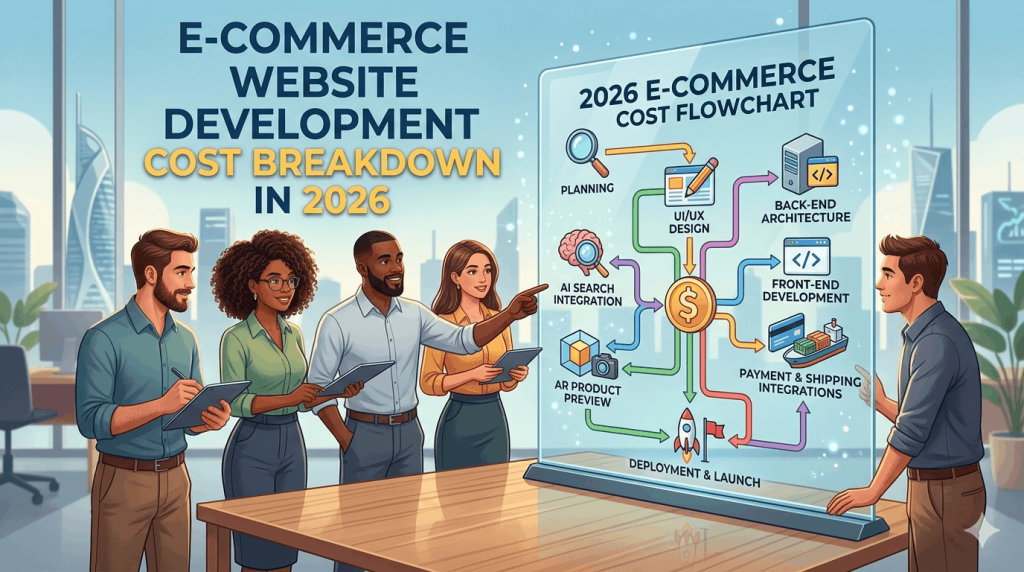
E-Commerce Website Development Cost Breakdown in 2026
We all know that e-commerce means more than product listing and a checkout page. There are now evolved features such as AI in e-commerce, headless e-commerce development, and progressive web apps for e-commerce that add both functionality and cost. Knowing which features your online store needs and doesn’t substantially improve site performance and prevent overspending. The following breakdown explains all the steps you need to invest wisely.
Initial Build Costs
The starting point for e-commerce costs depends on whether you build it yourself or hire an e-commerce website development company. These early expenses usually include setting up the platform, choosing a theme, configuring essential features, and preparing the store so it can start accepting orders.
DIY Build Cost
DIY build means creating and setting up the e-commerce website on your own without hiring a developer or agency. This is usually done through ready-made templates and features that require minimal customization provided by platforms such as Shopify, Woocommerce or Wix. Basic DIY e-commerce builds cost between $0 and $450 initially.
Professional Design Cost
Hiring professionals can cost you 1500 dollars at least, and it only goes up from there. Many designers still work from templates but customize them to match your brand. Some agencies charge well over $1,500 just to add text and swap stock images on a template.
Custom development from an e-commerce website development company costs significantly more. A full start-to-finish personalized website design ranges from $10,000 to $100,000. It all depends on the complexity, features, and developer experience. Custom coding tasks typically cost around $200 per hour. Some agencies provide customization and mobile-first e-commerce design optimization services for less than others. Getting multiple quotes and reviewing previous work helps identify fair pricing.
Development Platform Cost
Platform and hosting costs are recurring expenses you pay monthly or annually to keep your e-commerce store running. The more upgraded and functional your e-commerce website is, the more additional costs will pile up. However, it is important not to compromise on the latest in-demand features, such as AI in e-commerce, headless e-commerce development, and mobile-first e-commerce design, as doing so can significantly leave you behind competitors. Entry-level features can cost around $15 – $30 per month on most platforms. Higher-tier plans with advanced features range from $79 to $299 monthly. Enterprise plans can cost $2,000 or more per month.
Usually, a website builder package comes with hosting. An advertisement-free entry-level hosting starts at $15 and reaches up to $20 monthly. As your store scales, you will need a package with more resources and options, which typically costs between $50 – $150 per month. If your store is a high-traffic one, you will need a dedicated hosting which costs stores 100 – 500 dollars monthly. Your domain name costs between $10 and $35 annually. SSL certificates encrypt customer data during checkout; they are crucial. Most hosts include basic SSL in paid plans. If you need a stronger SSL to avoid any customer data leak, expect to pay $8 to $270 annually.
Functional Features Add-On Costs
These modern features that improve the functionality of an e-commerce store are a must-have investment. Some of them are affordable, while others land on the rather costly side. You must consult professionals to decide which one fits your business needs the most for e-commerce website optimization.
Progressive web apps in e-commerce are a must as they offer the features of an application on the web. They successfully bridge the gap as they offer a single, cross-platform codebase, making them fast, secure, and discoverable via search engines. PWAs also come with a significantly lower site speed as compared to traditional sites, including offline browsing and push notifications. Implementing a PWA ecommerce benefits can boost your sales by a huge margin, and it typically adds $3,000 to $15,000 to development costs. The results are visible in improved conversion rates and better mobile performance.
E-commerce personalisation AI allows dynamic pricing. This system can adjust product prices based on demand and inventory checks. Many merchandising tools also integrate with AI to create a smooth transition. It also shows different content on the top to different users, catering to each individual’s needs and consumer behaviour. This increases conversions by making the shopping experience more relatable. Basic AI features through third-party apps cost $50 to $300 monthly. Custom AI implementation adds $10,000 to $50,000 to development costs.
Headless e-commerce development separates the front end from the back end, which provides more architectural flexibility. The back end shares data through APIs, and the front end of any system, mobile, desktop, or any other device can use the same data. That’s why headless setups are quicker and easier to adapt.
The front end, when built separately, can also be designed using modern tools that focus on speed and performance. Headless is a good choice when a business needs advanced customization or wants to sell across multiple platforms and customer touchpoints. This architecture adds $15,000 to $100,000 to development expenses. It benefits businesses with an omnichannel ecommerce strategy that needs to sell through multiple channels.
Design and User Experience
Custom designing that curates a personalised user experience beyond the overused templates can cost between $3,000 to $25,000. This allows you to go beyond simple modifications to unique layouts, graphics, and a design that speaks for your brand. E-commerce UX trends in 2026 emphasize clean, minimalist designs to reduce checkout confusion and overwhelmingness.
Another emerging trend that prioritises user experience is Mobile-first ecommerce design. Professional designers ensure buttons are easy to tap, forms are simple to complete, and pages load quickly on mobile networks. For visuals, you are free to use free stock images from websites such as Pixabay, and it may seem like the cheaper option; however, it can create copyright issues in the long run. Product photography gives your e-commerce store credibility, and it usually costs $25 – $150 per product, depending on quality. Some website builders, such as Canva, include royalty-free images in their paid plans, which can be a safer option.
Checkout System Fees
Most payment processors charge 2.9% plus 30 cents per transaction for online payments. This applies to Stripe, PayPal, and Square. Some platforms add their own transaction fees of 0.5% to 2% on top of processor fees. Lower-tier plans often include transaction fees. Higher-tier plans typically eliminate these. For stores with significant sales, upgrading often saves money despite higher monthly costs.
Apps and Extensions
Most e-commerce stores require several apps for complete functionality. Something like an email marketing app will cost 10-300 dollars monthly. Inventory management tools range from free to $200 monthly. Reviews apps cost $0 to $50 monthly. E-commerce automation tools handle the recovery of cart abandonments and automated marketing techniques. These can cost you from $20 to $500 monthly. E-commerce website optimization apps for speed and SEO typically cost between $10 to $100 monthly total. An average e-commerce store can easily use 5-10 apps, which adds up to $50 to $500 in monthly costs.
Website maintenance and updates
A site requires maintenance from Regular updates, security patches, and bug fixes, which can cost $20 to $100 annually for basic stores. More complex custom stores usually require $1,000 to $5,000 annually. Platform-based stores handle most maintenance automatically. To keep updating your catalogue, you need to hire someone for roughly $25 to $100 per hour.
Development Cost Plans
E-commerce development costs vary widely depending on the size and complexity of the store. The following examples show typical budgets for a starter store, a mid-range setup, and an enterprise-level solution.
A Start-up e-commerce will cost
- Shopify Basic plan: $39/month
- Domain: $15/year
- Basic apps (3-4): $30/month
- Product photos (DIY): $0
- Email marketing: $15/month
- Total first year: ~$1,100 plus initial product costs
The Mid-Level Customised Store will include
- Professional design: $8,000
- Mid-tier platform: $79/month
- Domain and SSL: $50/year
- Apps and tools: $150/month
- Professional product photos: $1,500
- Total first year: ~$12,000
Enterprise-scale development can cost
- Custom development: $75,000
- Enterprise hosting: $300/month
- Advanced apps and integrations: $800/month
- Ongoing development: $2,000/month
- Total first year: ~$110,000
Cost Saving Strategies
Using templates intelligently saves design costs. Good templates exist. Customizing with your branding looks professional for a lower cost. Focus customization on elements that affect the conversion rate. Handling product photography yourself with a smartphone and basic lighting saves thousands. Modern phone cameras produce adequate product photos. Starting with essential apps prevents unnecessary monthly costs that can add up to a huge sum. Continue adding apps as you identify specific business needs.
Conclusion
E-commerce website development in 2026 cost starts from $1,000 for basic structures and go up to $100,000 for enterprise solutions, depending on business size, goals, and features. Up-and-coming technologies like AI in ecommerce, progressive web apps for ecommerce, and headless ecommerce development improve website efficiency and customer experience while driving up the developmental cost. What would work best is if you start with a simple platform to test out your business and scale gradually according to your needs