
Your first ideas for a business strategy should include a clearly planned brand design. In order to market effectively, attract ideal customers, or scale your operations, you need to establish an image of your brand. This image of our brand is referred to as branding. A strong branding design speaks louder than any sales executive. It creates a base that guides every business decision, from product development to customer service.
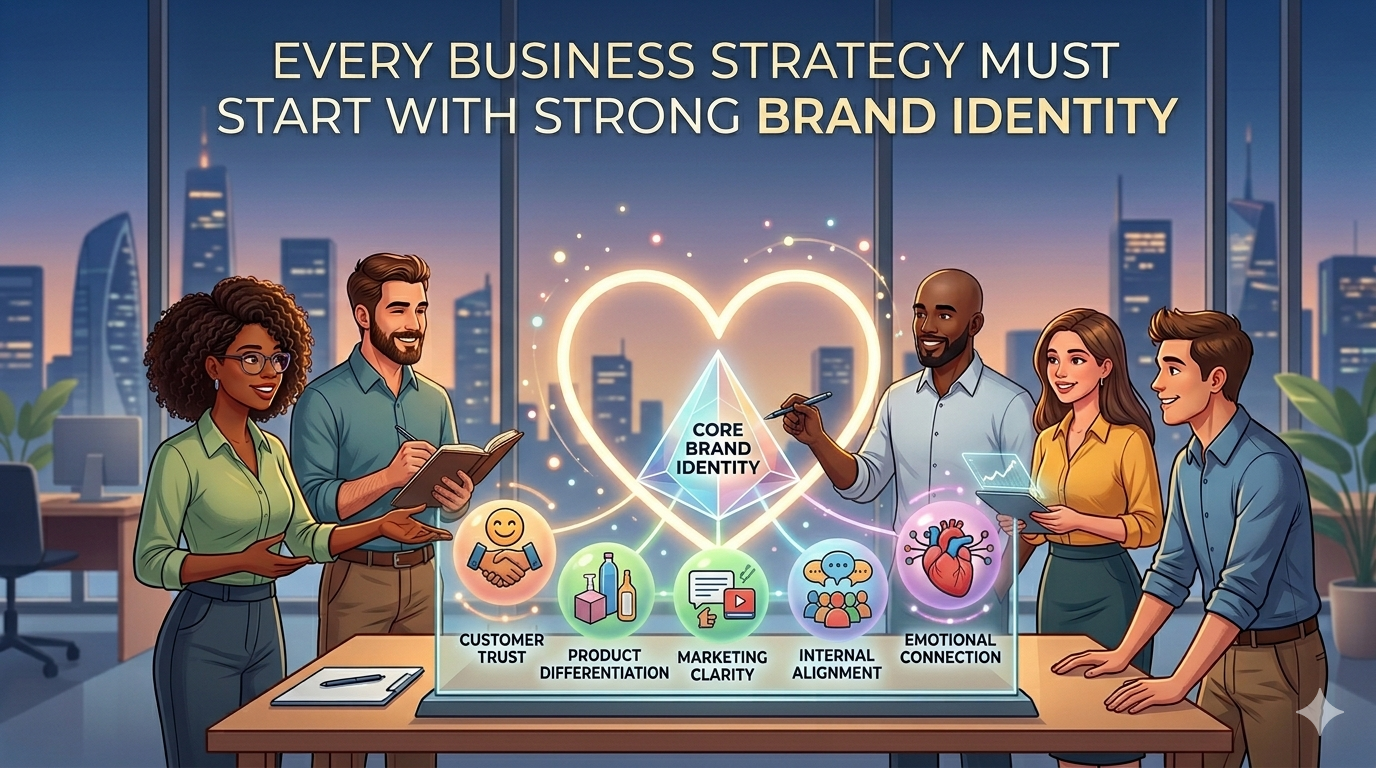
Why Every Strong Brand Strategy Needs To Begin With Branding
Brand identity constitutes more than a logo and typography; it includes visual elements, messaging, values, personality, and how customers perceive you. When all these components align with each other, they create credibility, which turns into customer trust and brand recognition that drives a consistently successful business. Businesses that think through and invest in brand identity design services consistently outperform those that view branding services as a secondary decision. Whether you’re a startup or an established company, understanding why branding comes first helps you build sustainable competitive advantages.
What Should Your Branding Kit Include:
A comprehensive brand kit presents a brand identity that helps people form first impressions of you. A brand design agency knows the important aspects of branding, and so should you. Key components include:
- Visual Identity: logo, colour palette, typography, and design system
- Verbal Identity: voice and tone of communication
- Brand Core Values: what your company stands for
- Brand Personality: giving your company human characteristics
All of these combined form a roadmap for which niche you attract, professional B2B sales or young teens? How will people view you, innovative and bold or traditional and reliable? All these decisions guide you to attract customers or clients who share similar beliefs. Working with a brand identity design agency helps ensure these components work together cohesively rather than sending mixed messages.
How Brand Identity Guides Strategy and Business Decisions
A brand identity should be mapped out before a business strategy because, otherwise, marketing, product development, and hiring decisions lack direction. A lack of brand identity has often proven to be a cause of business distress. Product managers rely on branding more than one might think. Once a brand design is established, it becomes easier to evaluate which product should be released next and what features it should include. Pricing strategy also aligns with brand positioning; whether you choose high prices to sell luxury products to a niche market or lower prices to sell to the masses often depends on your logo and overall brand design. Marketing teams rely on branding to decide which channels should serve as their core marketing platforms. Your brand identity helps determine where your customers are. It also influences customer service style, ensuring that every interaction with your audience reflects the brand’s core values. In many ways, it determines your business’s relevance.
For small businesses, strong branding is especially important because it helps them compete with larger companies by creating a unique emotional connection with customers that people all around the globe have been appreciating lately. For larger organizations, clear corporate branding ensures consistency across teams, departments, and locations.
The Competitive Edge of Strong Branding
| Factor | Weak Branding | Strong Branding |
| Brand Recognition | Inconsistent visual and message cues cause a forgettable brand identity | Consistent logos, colors, and design across all platforms increase brand recognizability |
| Customer Trust | An unpolished identity may give rise to suspicions or unreliability | Professional branding creates a polished image that builds credibility and trust faster |
| Pricing Power | A weak branding diminishes your perceived value and makes you unable to compete with market prices | Corporate branding services allow businesses to charge premium prices because customers trust the brand. |
| Customer Loyalty | A lack of emotional connection makes customers switch between competitors easily | Long-term customer relationships with emotional connection are based of a customised and unique branding |
| Marketing | Marketing teams make haphazard choices to find a promotional channel that benefits | Makes marketing easier as a narrowed-down audience and brand message is already set |
Custom Brand Design Services For Different Sizes
Various business sizes approach branding differently, but all of them need a strong foundation. A strong base helps build consistency, recognition, and long-term growth in competitive markets, while also ensuring they can adapt and scale.
Startups
Branding and Logo design services for startups establish credibility since the very beginning. New businesses without professional branding struggle to attract early customers. Investing in brand identity design services helps startups compete with established players. Startups benefit from flexible brand systems that grow with the company.
Small Businesses
Small businesses must distinguish between their chosen markets, whether they want to focus on local or niche markets. It is crucial to have practical brand guidelines that they can implement consistently, as this saves time in everyday decision-making and doesn’t require large marketing teams. A brand design company provides templates that make brand consistency achievable with limited resources.
Large Corporations
Corporate branding services manage complexity across divisions and regions. Large organizations need a comprehensive brand architecture. They require detailed brand guidelines, ensuring thousands of employees represent the brand accurately. Brand identity design services create documentation supporting this consistency.
The Brand Development Process
Discovery Phase
Understanding business goals, target customers, and the competitive landscape comes first. A brand identity design agency conducts research revealing what makes your business unique and what customers value.
Strategy Phase
Defining brand positioning establishes a unique space in the market for you. Targeting audiences precisely helps create relevant and efficient branding. Branding design agencies help you in deciding with audiences to prioritize.
Design Phase
Here is when the designers work, bringing the creative strategist’s ideas to life. Visual identity, such as logo concepts, color palettes, and typography systems are tested against criteria. Feedback loop systems help polish the final product through refinement.
Implementation Phase
Developing brand guidelines documents how to use brand elements correctly. Creating templates for common applications makes implementation easier. Training team members on brand standards helps everyone represent the brand appropriately.
Common Branding Mistakes to Avoid
Inconsistency in the application of branding elements confuses the consumer base and weakens recognition. Every interactive customer-brand touchpoint should reflect the same emotions. Another fault to look out for is accidental mimicking. Looking similar to an existing competitor defaces all genuineness and credibility. You cannot copy someones business model and their branding. Your distinctive branding is what will give an edge in the market.
Overly complex branding also proves to be difficult to use consistently over time. Simple, clear branding works across more applications and gets remembered more easily. Branding shouldn’t be decided by what you like; it should be consumer-centric. You should design to appeal to your desired audience so you don’t waste resources.
Conclusion
A strong brand identity should be the foundation of any business strategy since it directs choices about everything from hiring and marketing to product development, resulting in consistency that consumers can trust. Early investment in brand design services, whether through a brand design agency or specialized brand design services, helps prevent expensive errors and creates a competitive edge through increased growth, customer loyalty, and recognition. While companies that build their strategy on a strong brand identity foundation create lasting value, they start with who they are before deciding what to do and how to do it. Those who treat branding as an afterthought frequently face inconsistent messaging and weak differentiation.